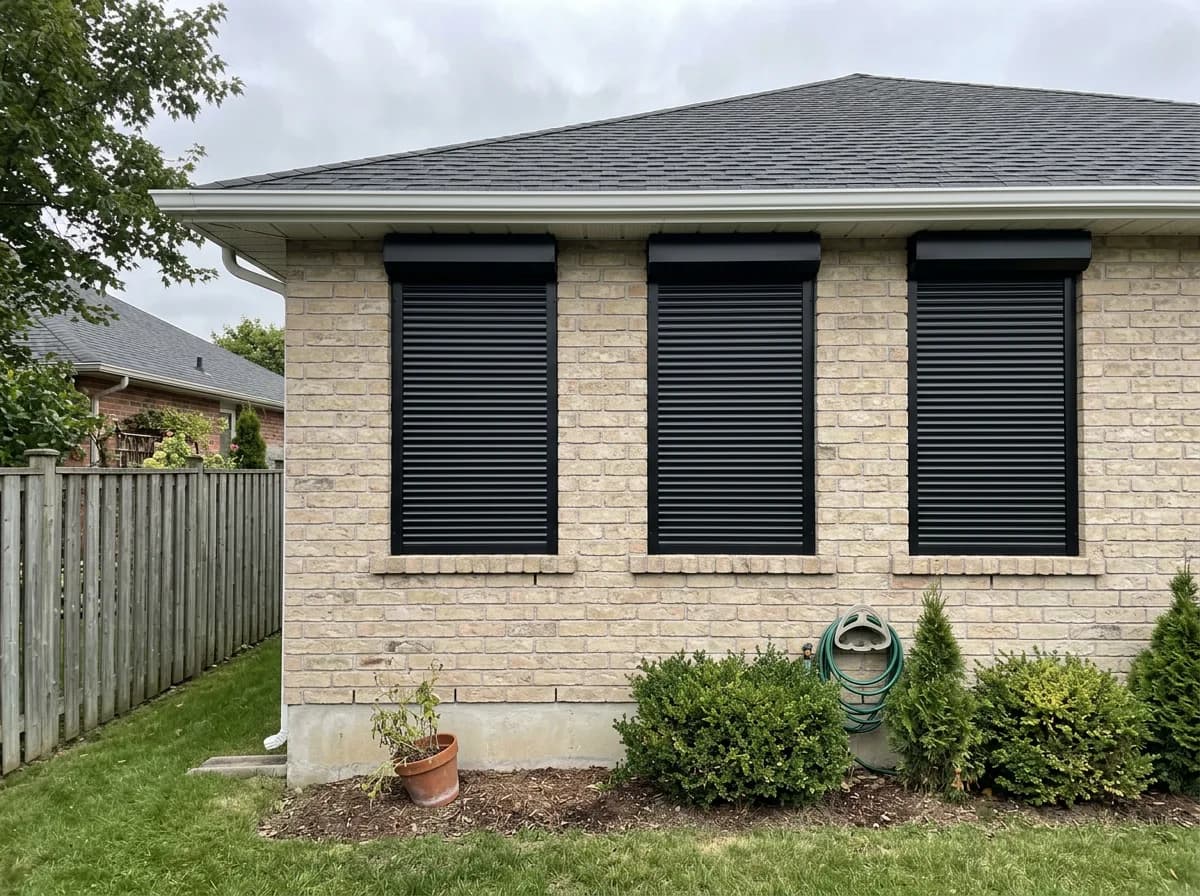
Honest Comparison
Security shutters vs window bars on an Ontario home.
Bars are real security infrastructure. So are security shutters. The right answer depends on whether the opening is residential or utility, whether it’s required egress, and what you want the property to look like every day.
- Canadian-made aluminum
- Custom-fit, every install
- Free site visit
- Across Ontario
- 8-year warranty
- Transparent pricing
Window bars are real security. So are security shutters.
Window bars — vertical or grid steel — are the oldest exterior security product in residential and commercial construction. On the right opening (basement utility window, commercial storefront, rural outbuilding) they remain a reasonable answer to a focused security problem.
Security-spec roll shutters are a different format — a heavier-gauge slat curtain with reinforced locking pins, retracting into a head box during the day and deploying for overnight or away protection.
For most Ontario residential installs the buying decision isn’t about which is more secure — both deter casual attempts and both have limits against determined entry. It’s about whether the opening is required fire egress, what you want the property to look like daily, and whether your insurance carrier will credit the install.
Side by side, line by line.
Both deter casual entry. The differences come down to aesthetics, code compliance, insurance, and what else the same hardware can do.
| Feature | Security shutters (myrollshutters.ca) | Window bars |
|---|---|---|
| Deterrence profile | Heavier-gauge slat curtain with reinforced locking pins anchored to the wall — full opening coverage, no visible weak point | Vertical or grid steel bars across the opening — strong against simple smash entry but signals 'this house has something to protect' |
| Daily aesthetics | Slats retract into a head box during the day — window looks normal from inside and outside | Bars are permanent and visible 24/7 from the curb and from inside the home |
| Fire egress (Ontario Building Code) | Code-compliant on the bedroom side — opens fully to clear the egress window with one motion | Permanent bars on a required egress window are a code violation in most Ontario municipalities; quick-release versions exist but introduce a single point of failure under panic |
| Insurance discount eligibility | Dedicated security spec sheet (slat gauge, locking spec, install address) accepted by most Ontario carriers for 5–15% home premium discount | Some insurers credit bars on a partial basis; many decline due to fire-egress liability concerns; varies sharply by carrier and underwriter |
| Daily light and visibility | Daylight comes through fully when retracted; full opaque close when deployed | Bars cast permanent shadow lines indoors; outward view is permanently obstructed |
| Storm and weather protection | Closed shutter takes wind load, ice load, and wind-borne debris — measurable storm protection | Open grid — no weather protection, no debris protection, no thermal value |
| Energy and blackout | Closed shutter creates an insulating air pocket and provides full blackout for bedrooms / media rooms | No insulating effect, no blackout — bars don't change daylight or thermal performance |
| Resale impact | Permanent infrastructure that reads as upgraded protection on listing; common on premium Ontario builds | Bars are sometimes flagged as a negative by buyer agents in residential neighbourhoods, suggesting elevated crime perception |
| Smart-home control | Somfy motors with TaHoma, Alexa, Google Home; scheduling, vacation mode, wind-sensor automation | Permanent fixed bars — no automation, no scheduling, no remote control |
| Best fit | Residential security upgrade where daily aesthetics and fire-code compliance matter alongside deterrence | Commercial storefronts, basement utility windows below grade, and rural outbuilding openings with no egress requirement |
Specs based on standard residential and commercial security product information at the time of writing. Egress-code interpretation varies by municipality; confirm requirements with your local building department before installing either product on a residential bedroom window.
Pick window bars when these things are true.
We’ll be the first to tell you. There are real cases where window bars are the right answer.
- You're protecting a basement utility window below grade with no fire-egress requirement and no aesthetic concern. Bars are cheaper and serve that single job.
- You're securing a commercial storefront or rear-loading door where the building isn't a residence and the daily-aesthetics question doesn't apply.
- You're protecting a rural outbuilding (detached garage, workshop, equipment shed) where the opening isn't bedroom or living space and the building code doesn't require egress.
- Your budget is firmly capped and the opening you're protecting is small, low-visibility, and won't be looked at every day.
Pick security shutters when these things are true.
Where security shutters tend to win on an Ontario residential install.
- You're protecting a bedroom, living room, or any required egress opening on a residential property. Security shutters meet Ontario fire code; permanent bars typically don't.
- You want the same product to handle security, blackout, sunshade, and storm protection. Bars do one job; security shutters serve four on the same hardware.
- You're applying for an insurance discount. Most Ontario carriers credit a documented security shutter install with a 5–15% home premium discount; bar credits are inconsistent across carriers.
- You don't want the property to look like it's behind bars from the curb or from inside the home. Security shutters retract into a head box during the day — invisible until deployed.
Rule of thumb
Bars on a basement utility window. Shutters on bedroom and living-room openings. Match the product to whether the opening is required egress and whether daily aesthetics matter on this elevation.
Mixing both on the same property is common — bars on the utility openings, security shutters on the residential openings, each product on the job it was designed for.
From first call to final install.
Three steps. No surprises. Most installs ship within 3–4 weeks of the consult.
Book a free quote
Tell us your opening size, what you're solving for, and your city.
Consult & measure
An installer visits your home, takes measurements, and walks you through slat gauge, motor, and smart-home options. Free of charge.
Install
Custom build at our shop, then a same-day install on your home. You're using the shutters that evening.
Honest limits on both products.
Both are deterrent layers, not invincibility. Worth saying out loud before you buy either:
- Neither product makes the home break-in proof. Both raise the cost and time of entry significantly. A determined intruder with the right tools and enough time can defeat either.
- Bars protect only the openings they cover. Front and rear door entries are unprotected and account for the majority of forced-entry attempts.
- Motorized security shutters need power. Manual override is the failsafe during outages. Bars are passive and don’t share this constraint.
- No exterior security product replaces the value of a monitored alarm and good lighting. The strongest installs pair physical hardening with monitoring; bars or shutters alone are partial coverage.
What buyers ask when comparing the two.
Still researching? Pivot to a related read.
Other comparisons buyers often read alongside this one. Honest framing on the next product or brand in your shortlist.
Roll shutters vs hurricane shutters
Ontario weather versus Florida engineering — match the product to the wind band.
Read comparisonRoll shutters vs storm panels
Permanent slat curtain versus bolt-on panels — deployment, storage, and lifetime labour.
Read comparisonRoll shutters vs impact windows
Layer over the existing window or replace the glazing — when each install scope wins.
Read comparisonFree site visit, honest answer.
Tell us your opening, your city, and what you’re protecting against. We’ll measure on-site, walk you through the security-spec line, and tell you straight if window bars are a better fit for that specific opening.
You get a written quote with the insurance-spec sheet included at no charge, ready to share with your broker.