Honest Comparison
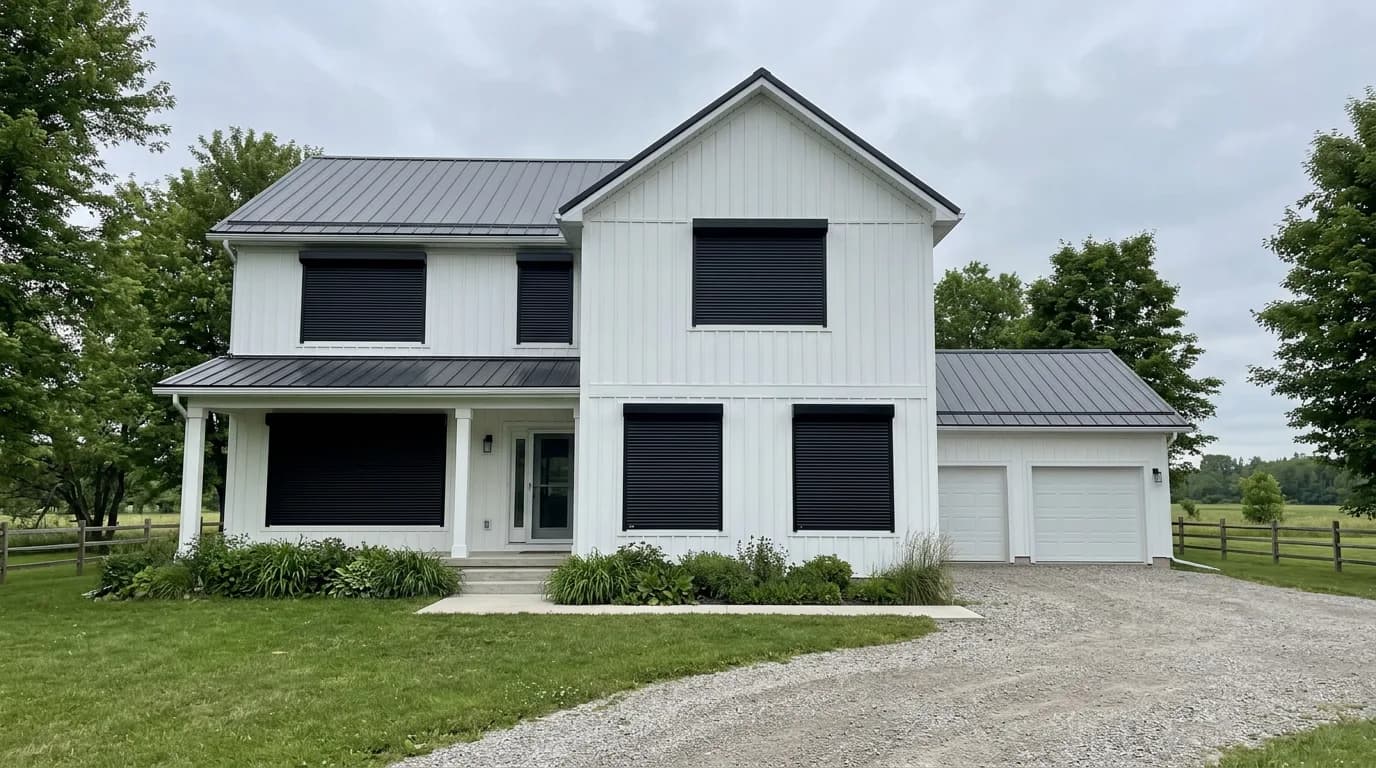
Roll shutters vs storm panels on an Ontario home.
Storm panels are real engineering at a real price. So are roll shutters. The right answer comes down to how often you’ll actually deploy and what else you want the product to do the other 363 days a year.
- Canadian-made aluminum
- Custom-fit, every install
- Free site visit
- Across Ontario
- 8-year warranty
- Transparent pricing
Storm panels are a real product. So are roll shutters.
Storm panels — aluminum or polycarbonate — are the cheapest hurricane shutter category. They get bolted to the wall during a storm watch and stored in a garage or basement between events. For a Gulf Coast or Florida home that deploys every season, they’re a reasonable answer to a focused problem.
Roll shutters are a different format — a permanent slat curtain rolling into a head box above the opening, operating daily for blackout, sunshade, security, energy seal, and storm protection all on the same hardware.
For an Ontario address, the buying question is usually less about which product is better in the abstract and more about what else you want the same hardware to do between storm events. We’ll walk through the trade-off honestly.
Side by side, line by line.
Both protect openings during a storm watch. The differences live in deployment speed, lifetime labour, and what the product does between events.
| Feature | Roll shutters (myrollshutters.ca) | Storm panels |
|---|---|---|
| Product format | Permanent slat curtain rolling into a head box above the opening | Removable aluminum or polycarbonate panels bolted to the wall for each storm event |
| Deployment time | Whole-house close in under a minute from a single switch or app (motorized) | 30–60 minutes per opening — manual ladder work, panel by panel |
| Storage between events | Slat curtain stows inside the head box — no storage required, no labour between uses | Panels must be stored (garage, basement, shed) and carried out for each deployment |
| Daily use | Operates daily for blackout, sunshade, security, energy seal, smart-home schedules | Storm protection only — installed during watch warnings, removed after |
| Initial cost | Premium tier — single product covers multiple daily uses | Lowest-cost hurricane shutter category — typically 30–50% below comparable roll shutter spec |
| Lifetime labour | One install, then daily operation for 20+ years with no per-event labour | Per-event ladder labour every storm watch — 2–6 hours of physical work each time, plus take-down |
| Storm rating | Reinforced storm-spec line rated for Ontario wind regimes (lake-effect, derecho-band, escarpment exposure) | Polycarbonate and aluminum panels carry strong wind ratings — Miami-Dade NOA available at the high end |
| Aesthetic when not in use | Head box visible above the opening — clean, integrated, paintable | Bolted hardware (anchor bolts or tracks) remains on the wall year-round; panels stored elsewhere |
| Security spec | Dedicated security line with reinforced locking pins, insurance documentation included | Storm protection only — not designed for routine security or break-in deterrence |
| Best fit | Daily-use Ontario residential needing storm protection plus security, blackout, or smart-home control | Storm-only buyers in coastal hurricane zones who deploy a few times a season and value the lower entry cost |
Specs based on publicly available manufacturer product information at the time of writing. Storm panel ratings vary widely by manufacturer — confirm wind-load and ice-load specs with the panel supplier before purchase.
Pick storm panels when these things are true.
We’ll be the first to tell you. There are real cases where storm panels are the right answer.
- Your budget is firmly capped and storm protection is the only problem you're solving. Storm panels are the cheapest hurricane shutter category by a meaningful margin.
- You only need to deploy a few times a season, you're physically able to handle ladder work, and you have storage space for the panels between events.
- You're protecting a vacation property where daily blackout, security, and smart-home features have no value because no one is there day-to-day.
- You're working around a heritage approval that won't permit a permanent head box on the elevation — anchor bolts plus removable panels read more discreet when not in use.
Pick roll shutters when these things are true.
Where roll shutters tend to win for an Ontario primary residence.
- You want storm protection that deploys in under a minute, no ladder labour required. Bad weather doesn't always give 24 hours of warning. Roll shutters close on a switch.
- You want the same product to handle blackout, sunshade, security, energy seal, and storm protection. One install, five jobs.
- You're protecting a primary residence, not a seasonal property — daily duty cycle pays back the premium over storm-panel-only spec.
- You don't want the per-event labour. Twenty years of seasonal panel deployments is real time and physical risk; permanent roll shutter infrastructure removes that ongoing cost.
Rule of thumb
Storm panels make sense when storm protection is the only job you’re hiring the product to do and the budget is tight. Roll shutters make sense when you’re asking one product to handle storm, security, blackout, and energy seal across the same install.
Most Ontario primary residences end up in the second camp once the daily-use math is laid out at quote time.
From first call to final install.
Three steps. No surprises. Most installs ship within 3–4 weeks of the consult.
Book a free quote
Tell us your opening size, what you're solving for, and your city.
Consult & measure
An installer visits your home, takes measurements, and walks you through slat gauge, motor, and smart-home options. Free of charge.
Install
Custom build at our shop, then a same-day install on your home. You're using the shutters that evening.
Honest limits on both products.
Both are hardening layers, not invincibility. Worth saying before you buy either:
- Neither product makes a home tornado-proof or lightning-proof. They reduce wind-borne debris damage. They don’t change the underlying weather risk.
- Storm panels only protect the openings you actually deploy. If a panel gets skipped during a rushed deployment, that window has no protection.
- Motorized roll shutters need power. Manual override is the failsafe during outages. Both product families have a manual fallback during long outages.
- Storm panels need physical storage. Roll shutters need a head box on the wall. Both occupy real space — one inside the home, one on the building elevation.
What buyers ask when comparing the two.
Still researching? Pivot to a related read.
Other comparisons buyers often read alongside this one. Honest framing on the next product or brand in your shortlist.
Roll shutters vs hurricane shutters
Ontario weather versus Florida engineering — match the product to the wind band.
Read comparisonRoll shutters vs impact windows
Layer over the existing window or replace the glazing — when each install scope wins.
Read comparisonSecurity shutters vs window bars
Deterrence, daily aesthetics, fire-egress code, and insurance discount compared.
Read comparisonFree site visit, honest answer.
Tell us your opening size, your city, and how often you expect to deploy storm protection. We’ll measure on-site, walk through the storm-spec line, and tell you straight if storm panels are a better fit for how the property gets used.
You get a written quote line-by-line, ready to compare against any storm-panel quote.